If you sell on cash on delivery (COD), a normal affiliate program can quietly lose you money. Most affiliate tools pay commission when an order is placed. With COD, a placed order is only a promise: the customer can refuse the parcel, be unreachable, or return it. You still owe the affiliate, and you have also paid for shipping both ways.
This guide explains how COD affiliate marketing works when it is done right. The idea is simple: commission is approved only after the order is delivered and paid. Below you'll find the commission lifecycle, the rules to put in your terms, and how to set it up on Shopify.
Why standard affiliate programs break on COD
With card payments, the money is collected at checkout. The risks are refunds and chargebacks, and both are fairly rare. With COD, the money arrives only when the courier hands over the parcel. That changes three things:
- Failed deliveries are common. Customers change their mind, give a wrong address or phone number, or simply don't answer the door.
- Fake and impulse orders are cheap. Ordering costs the customer nothing, so a single post can bring in orders that never turn into money.
- You learn the result days later. Delivery takes days, and the cash takes a few more days to come back from the courier.
If you pay affiliates on placed orders, every refused parcel costs you twice: the return shipping and the commission. Worse, an affiliate can be paid for traffic that never buys anything. Over time the program attracts the wrong partners.
The fix: a delivery-based commission lifecycle
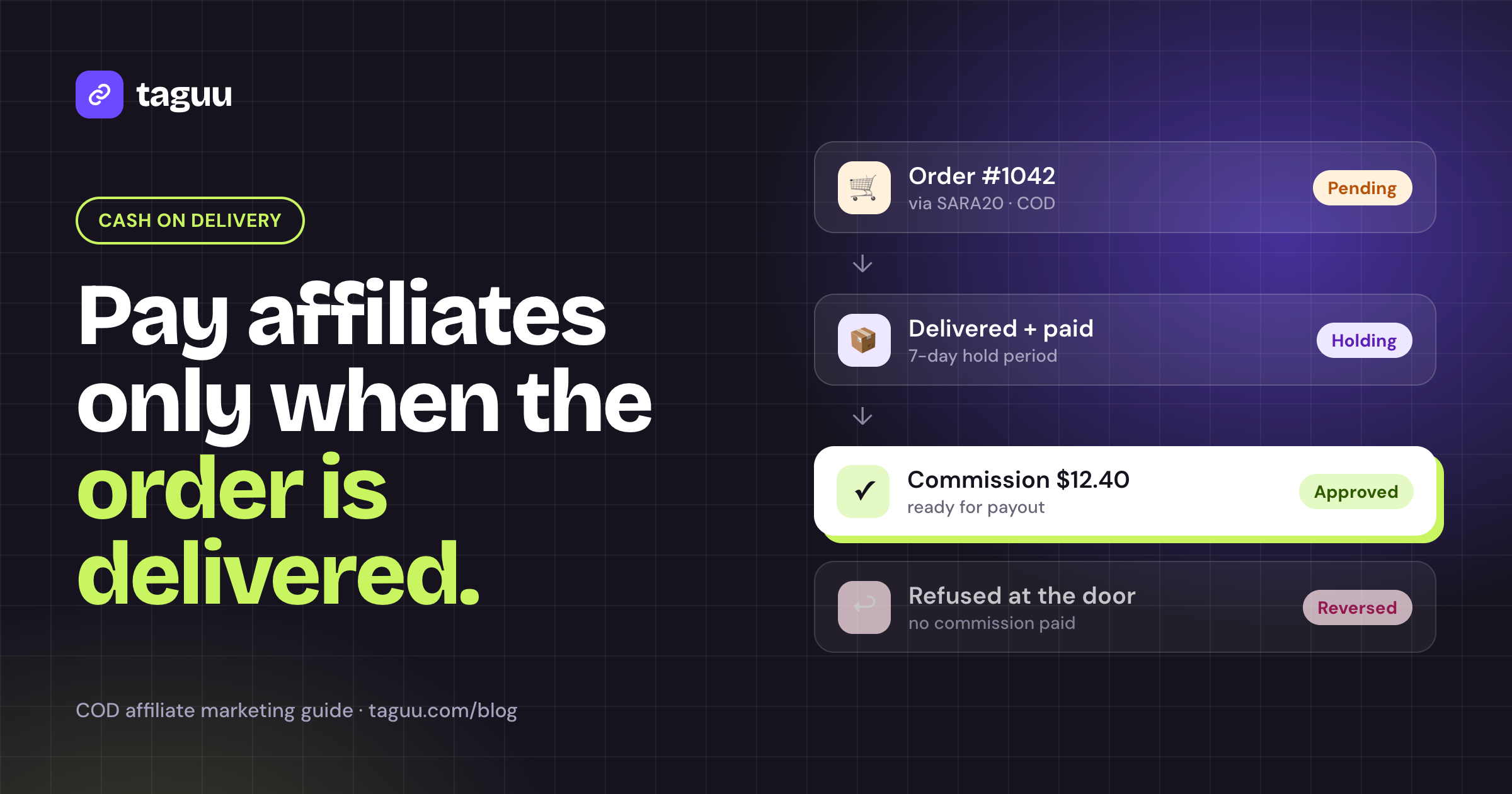
A COD-safe program tracks every commission through clear states:
| Status | What it means | Affiliate sees |
|---|---|---|
| Pending | Order placed through the affiliate's link or coupon | Expected earnings |
| Approved | Order delivered, paid, and the hold period has passed | Ready for payout |
| Reversed | Cancelled, refused at the door, returned or refunded | No commission, with the reason |
| Paid | Included in a payout you recorded | Payout reference |
The two rules that make this work:
- Approve on delivery, not on order. A pending commission becomes approved only once the courier has delivered the order and the cash was collected (or the fulfillment is marked delivered).
- Add a short hold period. Wait a few days after delivery before approving, to cover returns. Seven days is a sensible default; match it to your return policy.
A refused order should never cost you a commission. A delivered order should never leave your affiliate waiting without an explanation.
What counts as "delivered" for a COD order?
On Shopify, the clearest signal is the fulfillment status. When your courier integration updates the shipment to Delivered, the order counts as delivered. Many COD stores also mark the order as paid once the courier sends the cash. A fulfilled order that is marked paid is a reliable "delivered" signal too.
Everything else should reverse the commission:
- The order was cancelled before shipping
- The delivery failed or the customer refused the parcel
- The order was returned or refunded after delivery
Partial refunds are a special case. If the customer keeps two items and returns one, recalculate the commission on what was kept instead of reversing all of it. Your affiliates will notice the fairness.
How to attribute COD orders to the right affiliate
COD customers often order through a form app or a quick checkout. Some of these drop tracking data. Use more than one signal, in this order:
- Affiliate coupon code. If the customer used a code that belongs to an affiliate, that affiliate gets the order. This is the most reliable signal, and it works even when people share the code on WhatsApp or in a video.
- UTM parameters from the visit. Shopify records where the customer came from (
utm_source,utm_content). A link like?utm_source=taguu&utm_content=sara20ties the visit to the affiliate. - A referral cookie saved in the cart. When the journey data is missing, a first-party cookie from the affiliate link (for example
ref=SARA20) still tells you who sent the customer.
Last affiliate click wins: if a customer clicked two affiliate links, the most recent one gets the commission.
Protect the program from fraud
COD makes some abuse easier, so build these checks in from day one:
- Self-referrals. An affiliate orders through their own link to earn commission on their own purchase. Compare the order's email and phone with the affiliate's details. On a match, record the order with zero commission and flag it for review.
- Repeat customers through one affiliate. One phone number placing many orders in a short time through the same affiliate deserves a look. Pay normally, but flag it.
- Many reversed orders. An affiliate whose orders are refused far more often than your average may be sending low-intent traffic. Talk to them before you pause them.
Write it into your program terms
Clear terms prevent most disputes. Include these lines in your affiliate agreement:
- Commission is earned on delivered and paid orders only.
- Commission is approved X days after delivery (your hold period).
- Cancelled, refused, returned and refunded orders earn no commission.
- Payouts happen once a month on a fixed day, above a minimum balance.
- Orders placed by the affiliate themselves do not earn commission.
Then show affiliates the status of every order. "Pending" with a reason is much easier to accept than a mysterious number that changes.
Paying affiliates in COD markets
Your affiliates may not all have a bank account in the same country, or one at all. Offer the methods they actually use: bank transfer, local mobile wallets, or PayPal. Pay on a fixed day each month, record a transaction reference for every payout, and show the affiliate a statement that matches the reference. Never store full account numbers where your staff can browse them. Store a masked label like Wallet •••• 4521 instead.
Setting it up on Shopify with Taguu
Taguu was built for exactly this. It is a Shopify affiliate app designed for stores that sell on cash on delivery:
- COD-safe commissions: pending → approved only after delivery and your hold period, with automatic reversal for refused, cancelled and returned orders.
- Three attribution signals: coupon, UTM and referral cookie, so orders from COD form apps still find their affiliate.
- Self-referral and repeat-customer checks flagged for review.
- An affiliate portal where every affiliate sees their orders and statuses, without any customer details.
- Payouts to bank, wallet or PayPal, recorded with references.
Your data stays in your own Shopify store. If you are just getting started, read our step-by-step guide to starting a Shopify affiliate program. To set your rate, see how much commission to pay affiliates.
FAQ
Should I pay affiliates on placed orders or delivered orders?
For COD stores, pay on delivered orders. Paying on placed orders means you pay for refused parcels and fake orders. With prepaid orders, refunds are rarer, but a short hold period is still smart.
How long should the hold period be?
Long enough to cover your return window. Seven days after delivery works for most stores. If you accept returns for 14 days, use 14.
Will affiliates accept waiting until delivery?
Yes, if you are transparent. Show each order's status, explain reversals, and pay on time every month. Affiliates mostly leave programs because of surprises, not because of fair rules.
Can I still give affiliates a discount code?
Yes. A coupon per affiliate is optional, but it helps people who share on WhatsApp or in videos where links are awkward. It is also the strongest attribution signal.