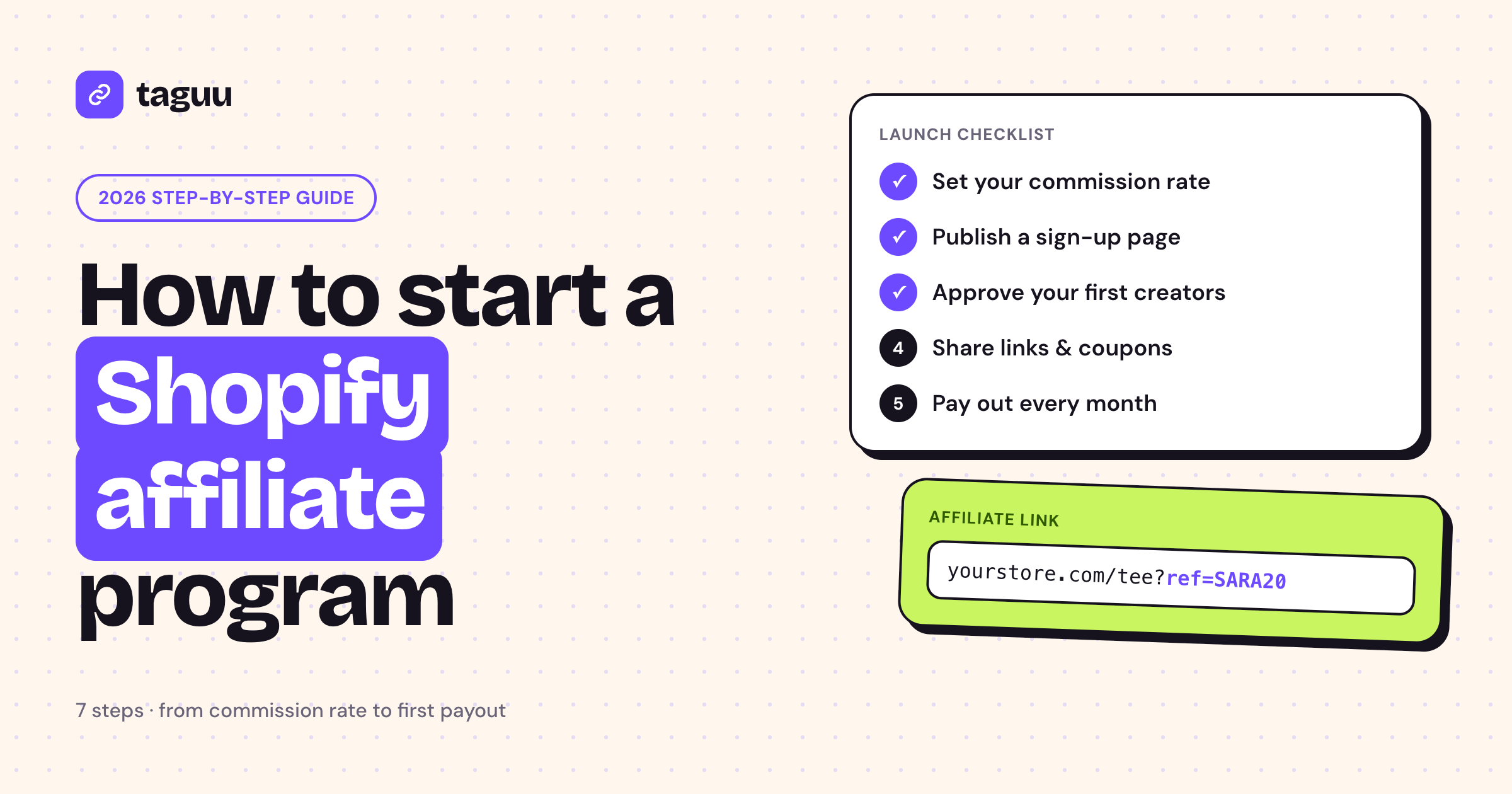
A Shopify affiliate program turns creators, customers and fans into a sales team that you pay only when they sell. There are no upfront influencer fees and no ad budget burned on clicks. You pay a commission on real orders.
This guide walks you through how to start an affiliate program on Shopify in seven practical steps, from choosing a commission rate to sending your first payout. It works for a brand-new store and for a store that already has fans asking to promote it.
What is a Shopify affiliate program?
It is a partnership where people (affiliates) share your products with their audience using a unique link or coupon code. When someone buys through it, the affiliate earns a commission, usually a percentage of the sale.
Affiliates can be:
- Creators and influencers on Instagram, TikTok and YouTube
- Happy customers who recommend you to friends
- Resellers and community admins who share in WhatsApp groups
- Bloggers and review sites
Unlike a paid influencer post, an affiliate program is performance-based: no sale, no cost.
Step 1: Decide your commission rate
Start from your margins, not from what competitors advertise. A simple rule: the commission should be a share of your gross profit, not of the price. That share should still leave room for shipping, returns and payment fees.
Most physical-product stores start between 10% and 20% of the order subtotal. Beauty and fashion tend toward the higher end; electronics toward the lower end. We break down the math in how much commission to pay affiliates.
Also decide:
- Percent or fixed amount per order
- Cookie window: how long after a click an order still counts (30 days is common)
- Custom rates: a higher rate for your best creators
Step 2: Write simple program terms
Keep the terms short enough that people actually read them:
- What earns commission (and what doesn't: self-purchases, cancelled or refunded orders)
- When commission is approved (for example 7 days after delivery)
- When and how you pay (for example on the 25th of every month, above a minimum)
- What affiliates may not do (bid on your brand name in ads, spam, make false claims)
If you sell on cash on delivery, make commission depend on delivery. Our COD affiliate marketing guide explains why.
Step 3: Install an affiliate app
You can run a tiny program with spreadsheets and discount codes. It breaks as soon as you have more than a handful of affiliates. A Shopify affiliate app handles the tedious parts:
- Unique tracking links for every affiliate
- Attribution of orders (link, coupon or cookie)
- Commission statuses: pending, approved, reversed, paid
- A portal where affiliates see their own numbers
- Payout records
What to look for: attribution that survives your checkout flow, refunds handled automatically, an affiliate portal that hides customer details, and fair pricing as you grow.
Step 4: Publish an affiliate sign-up page
Make it easy to join. Your sign-up page should show:
- Your logo and brand colors
- What affiliates earn and how they get paid
- Three to five clear benefits ("15% on every delivered order", "Paid monthly", "Free product to review")
- A short form: name, email, phone, main platform, profile link
Link to it from your store footer, your Instagram bio and your order confirmation email. Your best affiliates are often existing customers.
Step 5: Approve and onboard your first affiliates
Review applications against a simple checklist: does their audience match your customer? Is the engagement real? You can auto-approve to grow fast, and pause anyone who doesn't fit.
Send every new affiliate a welcome email with:
- Their personal link and code
- Three products to start with and why they sell
- Ready-made photos and banners (a creatives folder)
- Your do's and don'ts
The first week decides whether an affiliate stays active, so make the first post easy.
Step 6: Give every affiliate links and an optional coupon
A good affiliate link looks like this:
https://yourstore.com/products/linen-shirt?utm_source=taguu&utm_content=sara20&ref=SARA20
The UTM parameters let Shopify analytics show which affiliate sent each visit and sale. The ref code is a backup that is stored in a cookie. Affiliates should be able to create a link for any product, not only your homepage.
A personal coupon code (like SARA20 for 10% off) is optional but powerful. It converts better and tracks orders even when the customer never clicks a link, for example after watching a video.
Step 7: Track, approve and pay on schedule
Every month:
- Check that pending commissions moved to approved after delivery
- Review flagged orders (self-referrals, repeat customers)
- Pay approved balances above your minimum, and record the transaction reference
- Share a short update with your affiliates: top products, new creatives, a small bonus for top performers
Paying on time, every time is the single best way to keep good affiliates.
Bonus: let affiliates recruit affiliates
Once your program is running, add an invite & earn reward. An affiliate who brings in another creator earns a small bonus (for example 20% of that creator's approved commission), paid by you on top. The new affiliate's earnings are never reduced. Keep it to one level so it stays a referral bonus and never becomes a pyramid.
Common mistakes to avoid
- Paying on placed orders when many orders get cancelled or refused
- Too low a rate to motivate anyone, or so high it kills your margin
- No creatives: affiliates won't shoot product photos for you
- Late or unclear payouts
- Recruiting only big influencers. Micro-creators and real customers usually convert better.
Start your program with Taguu
Taguu is a Shopify affiliate app with everything in this guide built in: branded sign-up pages, product links and optional coupons, delivery-based commissions, invite & earn, an affiliate portal and payout tracking. All your data stays in your own Shopify store, and you can be live the same day. See pricing or install Taguu.
FAQ
Does Shopify have a built-in affiliate program?
Shopify has the Shopify Collabs app for creator partnerships. Many stores use a dedicated affiliate app for custom commission rules, coupons, payouts and an affiliate portal.
How much does it cost to start an affiliate program?
The app subscription plus the commissions you pay on actual sales. There is no upfront cost per affiliate.
How many affiliates do I need?
Start with 10 to 20 active ones. A few dedicated affiliates often drive most of the sales.
Can customers become affiliates?
Yes, and they are often the most trusted promoters. Add your sign-up link to your order confirmation emails.