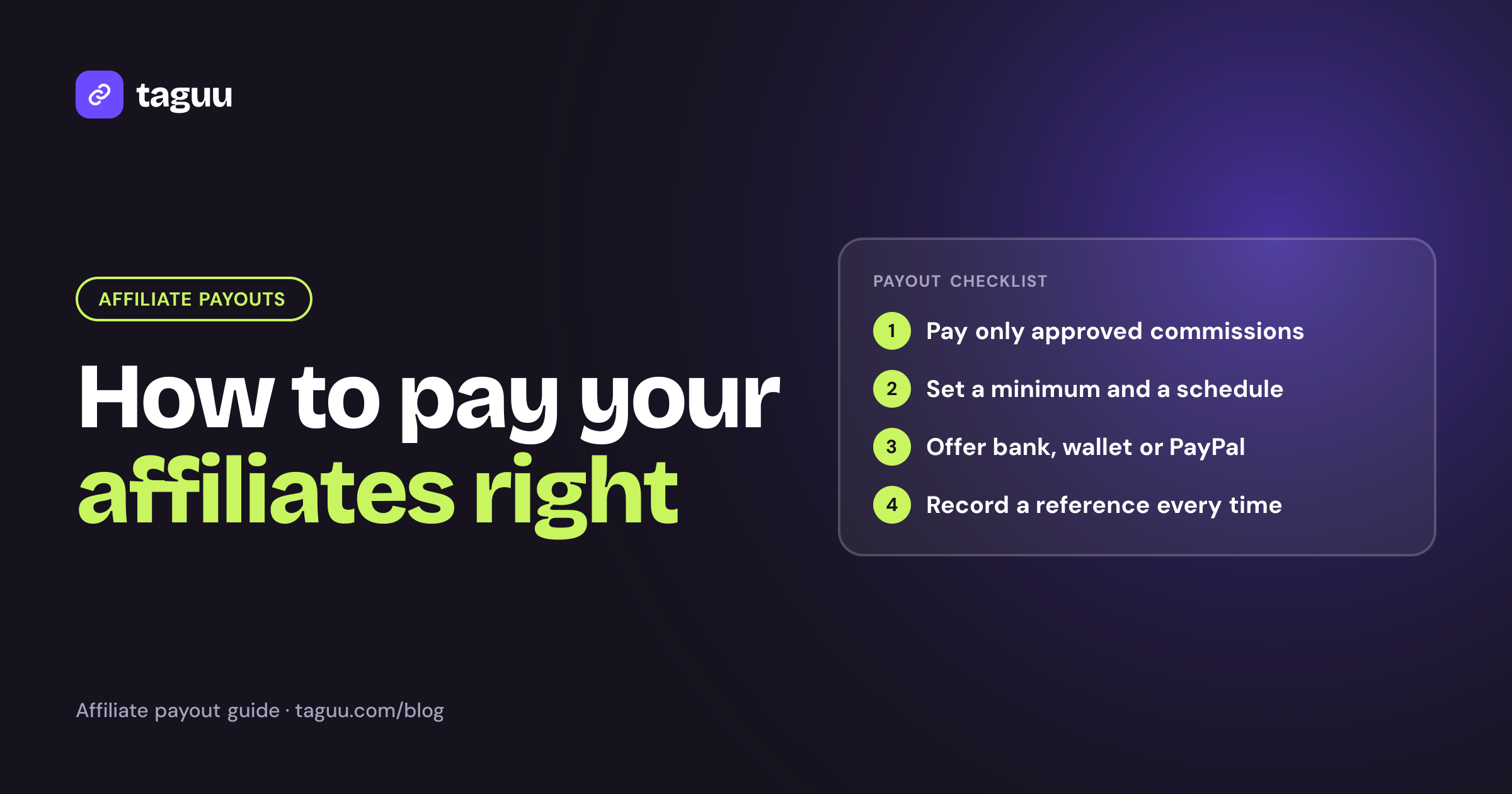
Knowing how to pay affiliates is just as important as recruiting them. Late, confusing or expensive payouts are one of the fastest ways to lose good partners. This guide covers the three main payout methods (bank transfer, mobile wallet and PayPal), how to set a payout schedule, and how to keep clean records, with extra care for stores that sell on cash on delivery (COD).
Why your payout process matters
Affiliates work for your store on commission. They put their time, audience and reputation behind your products before they see any money. When the money finally comes, they expect three things:
- It arrives on time. A clear schedule builds trust. A missed payout can end the relationship.
- It arrives in a form they can use. A bank transfer is useless to someone who only has a mobile wallet.
- They can see how it was calculated. Affiliates want to match each payout to the orders behind it.
A good payout process also protects you. If you pay commission before an order is final, you can end up paying for orders that were later cancelled, refused or refunded. That risk is much higher for COD stores, where a large share of orders can fail at the door.
Step 1: Decide when a commission is ready to pay
Before you choose a payment method, decide when a commission becomes payable. Most programs use three stages:
- Pending. The order was placed through the affiliate, but it is not final yet.
- Approved. The order is final and the commission is safe to pay.
- Paid. You sent the money and recorded the payout.
For prepaid orders, "final" usually means the order was fulfilled and your return window has passed. For COD orders, it should mean the parcel was delivered and the cash was collected, plus a short hold period for returns. We explain this in detail in COD affiliate marketing: pay commission only on delivered orders.
A hold period of 7 to 30 days is a typical starting point. Shorter holds keep affiliates happy. Longer holds give you more protection if your return policy is long.
Step 2: Set a minimum payout and a schedule
Paying every small commission the moment it is approved creates a lot of work and a lot of transfer fees. Two simple rules solve this.
Minimum payout threshold
Set a minimum balance an affiliate must reach before you pay. Typical starting points are $20 to $50. Below that, the balance rolls over to the next cycle. Keep the threshold low enough that new affiliates can reach it in their first month or two, or they may lose interest.
Payout schedule
Pick a fixed rhythm and publish it:
- Monthly is the most common. For example, "We pay approved commissions between the 1st and 5th of each month."
- Twice a month suits programs with very active affiliates who rely on the income.
- Weekly is rare and usually only worth it for large, high-volume partners.
Write the threshold, the schedule and the hold period into your affiliate terms. Our affiliate program terms and conditions template includes a payment clause you can copy.
Step 3: Choose your payout methods
Most stores offer one to three payout methods. The right mix depends on where your affiliates live and what they already use.
Bank transfer
A direct transfer from your business bank account to the affiliate's account.
Pros:
- Works almost everywhere and feels official.
- Usually low cost for domestic transfers.
- Easy to match against your bank statement.
Cons:
- You need to collect and store account details (account name, number, bank, and an IBAN or routing number depending on the country).
- International transfers can be slow and costly, and currency conversion adds fees.
- Typos in account numbers can delay or misdirect payments.
Best for: affiliates in the same country as your business, and larger payouts where a flat fee is small compared with the amount.
Mobile wallets
In many emerging markets, mobile wallets are how people actually move money. Examples include M-Pesa in Kenya, JazzCash and Easypaisa in Pakistan, bKash in Bangladesh and GCash in the Philippines.
Pros:
- Many affiliates, especially students, creators and resellers, have a mobile wallet but no bank account they use often.
- Transfers are usually fast.
- Affiliates only need to share a phone number linked to their wallet.
Cons:
- Wallets are usually domestic, so they work best when you and the affiliate are in the same country.
- Wallets often have daily or monthly transaction limits, so very large payouts may need to be split or sent by bank.
- Each provider has its own business account process and fees.
Best for: COD stores in markets where mobile money is common, and programs with many small affiliates.
PayPal
PayPal lets you send money to an affiliate's email address. For larger programs, PayPal Payouts (also called Mass Pay) lets a business pay many recipients in one batch.
Pros:
- Affiliates only need to share an email address.
- Works across many countries and currencies.
- Batch payouts save time when you have many affiliates.
Cons:
- PayPal is not available in every country, and in some countries accounts can send but not receive. Check before you promise it.
- Fees and currency conversion costs vary by country. PayPal publishes Payouts fees on its fee page for each country, often as a percentage with a cap per recipient. Check your own country's page before you budget.
- Some affiliates lose part of the payout when they withdraw to their bank.
Best for: international affiliates and programs that pay many people in different countries.
Comparison table
| Method | What you collect | Speed | Cost | Best for |
|---|---|---|---|---|
| Bank transfer | Account name, number, bank details | Same day to several days | Low domestic, higher international | Domestic affiliates, larger payouts |
| Mobile wallet | Wallet phone number and name | Usually fast | Varies by provider | COD and emerging markets, small payouts |
| PayPal | PayPal email | Usually fast | Percentage fee, varies by country | International affiliates |
Speeds and costs depend on your country, your bank and the provider, so treat this table as a general guide, not a quote.
Other options
Some stores also pay with store credit or gift cards. This works well for customer referral programs, where people are happy to earn discounts. For affiliates who promote you as a source of income, cash is usually expected. If you offer store credit, make it optional and consider a slightly higher value to make it attractive. To learn when a referral program fits better than an affiliate program, read referral program vs affiliate program.
Step 4: Collect payout details safely
Payout details are sensitive. Handle them with care:
- Ask affiliates to enter their own details in a sign-up form or portal instead of sending them by chat or email.
- Confirm the name matches the affiliate's account name. Paying a different person's account is a common source of disputes and fraud.
- Limit who can see the data. Only the people who send payouts need access.
- Re-check after any change. If an affiliate changes their bank or wallet details right before a payout, confirm the change with them through a second channel.
Step 5: Record every payout
Every payout should leave a clear trail. For each one, record:
- The affiliate and the period it covers.
- The orders and commissions included.
- The amount and currency.
- The method (bank, wallet, PayPal).
- A reference, such as the bank transaction ID, wallet transaction number or PayPal transaction ID.
- The date sent.
This record answers almost every affiliate question ("Did you pay me?" "Which orders were included?") in seconds. It also helps your accountant at the end of the year.
Step 6: Think about tax and compliance
Tax rules depend on where your business is and where your affiliates live. This is general information, not tax advice, so check with a local accountant.
A few common points:
- United States. US businesses usually collect a Form W-9 from US affiliates and may need to file Form 1099-NEC for those they pay above the reporting threshold. Under the One Big Beautiful Bill Act, that threshold rose from $600 to $2,000 for payments made in 2026, and it will be adjusted for inflation from 2027. Affiliates still owe tax on income below the threshold. Non-US affiliates paid by US businesses usually provide a Form W-8BEN instead.
- Other countries. Many countries have withholding tax or reporting rules for payments to individuals. Ask your accountant whether you need to withhold anything or collect a tax ID.
- Currency. Decide which currency you pay in. Paying in your store's currency is simplest, and the affiliate handles conversion on their side. State this in your terms.
Special tips for COD stores
COD programs need a little extra discipline because so many orders can fail after they are placed.
- Never pay on "order placed." Pay only after the order is delivered and the cash is collected, plus your hold period.
- Reverse commissions automatically for cancelled, refused, returned and refunded orders. Doing this by hand gets messy fast.
- Recalculate partial refunds. If a customer returns one item from a three-item order, the commission should drop to match.
- Show affiliates their pending balance. When affiliates can see why a commission is still pending, they ask fewer questions and trust the process.
- Offer local payout methods. In many COD markets, a mobile wallet is the easiest way to pay. Our guide to affiliate marketing for COD stores in Pakistan shows how this works in one major COD market.
Common payout mistakes to avoid
- Paying before orders are final. You end up paying for refused or returned orders.
- No published schedule. Affiliates chase you for money, and trust drops.
- Hidden fees. If a transfer fee is deducted from the payout, say so in your terms.
- Manual spreadsheets with no references. It becomes hard to prove what you paid and when.
- Only one payout method. You may lose good affiliates who cannot receive it.
How Taguu helps with affiliate payouts
Taguu is a Shopify affiliate app built for COD stores. It keeps commissions pending until an order is delivered (and paid, for COD) plus a hold period (7 days by default). Cancelled, refused, returned and refunded orders are reversed automatically, and partial refunds are recalculated. When you pay, you record the payout in Taguu with the method (bank transfer, mobile wallet or PayPal) and a reference, in your store's currency. Affiliates see their orders, earnings and payouts in their own portal. Taguu has a free plan with 50 affiliate orders per month and charges a 0% fee on sales on every plan. You can install Taguu and try it on your store.
FAQ
How often should I pay affiliates?
Monthly is the most common schedule and a good starting point. Pay approved commissions on fixed dates, such as the 1st to 5th of each month, and publish the schedule in your affiliate terms.
What is a good minimum payout for affiliates?
A typical starting point is $20 to $50. Keep it low enough that new affiliates can reach it within their first month or two. Balances below the minimum roll over to the next cycle.
Should I pay affiliates by PayPal or bank transfer?
Offer what your affiliates can use. Bank transfer often suits domestic affiliates and larger payouts. PayPal often suits international affiliates, but it is not available in every country. In many COD markets, mobile wallets are the most practical option.
When should COD stores pay affiliate commissions?
Only after the order is delivered and the cash is collected, plus a short hold period for returns. Paying on "order placed" means paying for orders that may later be refused or returned.
Do I need to send tax forms to affiliates?
It depends on your country. In the US, businesses generally file Form 1099-NEC for US affiliates paid above the reporting threshold, which is $2,000 for payments made in 2026. Ask a local accountant about the rules that apply to you.