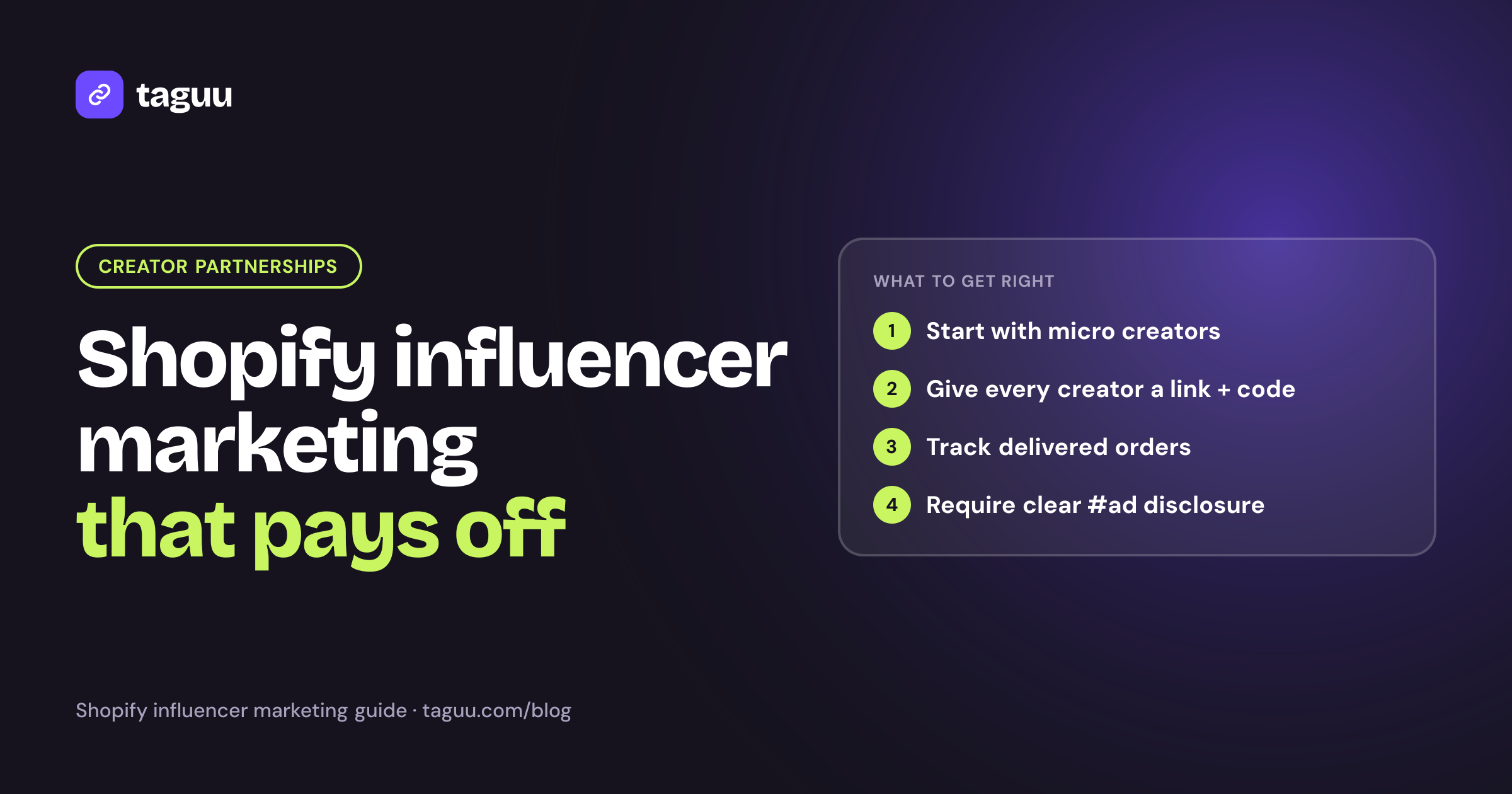
Shopify influencer marketing means paying creators to show your products to their audience, and tracking which sales they bring in. When you set it up well, influencers act like a sales team you only pay for results. This guide shows you how to plan, launch and measure a Shopify influencer marketing program, including what changes when your store sells on cash on delivery (COD).
What Shopify influencer marketing is (and is not)
Influencer marketing is a partnership. A creator with an engaged audience posts about your product. In return, you give them free products, a fixed fee, a commission on sales, or a mix of these.
On Shopify, the key part is tracking. Each influencer gets a unique link, a unique coupon code, or both. When a shopper buys, your store knows which creator sent them. That lets you:
- Pay commission only on real sales
- Compare influencers by revenue, not by likes
- Stop working with creators who do not convert
Influencer marketing is not the same as buying ads on a creator's account. A one-time paid post with no tracking is closer to advertising. It can build awareness, but you cannot measure it well. Most small Shopify brands get better results with a performance model: product plus commission, with tracking from day one.
Why it works for small and COD stores
Shoppers trust people they follow more than they trust a brand's own ads. A creator who uses your product on camera answers questions an ad cannot: How does it fit? How does it look in real light? Is it worth the price?
For COD stores, this trust matters even more. In many markets, shoppers choose cash on delivery because they are not sure about a new online brand yet. A familiar face reduces that doubt. A creator can also explain how COD works ("you pay when it arrives"), which can make first-time buyers more comfortable.
There is one risk. COD orders can be cancelled, refused at the door or returned. If you pay influencers when the order is placed, you may pay commission on sales you never collect. We cover how to avoid this later in the guide, and in more depth in our guide to COD affiliate marketing.
Types of influencers by audience size
The industry commonly groups creators by follower count. The exact cut-offs vary by source, but these are typical starting points:
| Tier | Typical followers | Best for | Common deal |
|---|---|---|---|
| Nano | 1,000 to 10,000 | Niche trust, local reach | Free product + commission |
| Micro | 10,000 to 100,000 | Engaged niche audiences | Product + commission, sometimes a small fee |
| Mid-tier | 100,000 to 500,000 | Wider reach with some trust | Fee + commission |
| Macro | 500,000 to 1 million | Big launches | Fixed fee, often with an agency |
| Mega | 1 million+ | Brand awareness | Large fixed fee |
For most small Shopify stores, nano and micro influencers are the best place to start. They usually cost less, reply to messages themselves, and often have closer relationships with their followers. You can work with ten micro creators for the cost of one large one, and learn which audiences actually buy.
How to build a Shopify influencer marketing program step by step
1. Set a clear goal
Pick one main goal for the first 60 to 90 days:
- Sales: orders and revenue from creator links and codes
- Content: photos and videos you can reuse in ads and on product pages
- Awareness: reach in a new city, country or niche
Sales goals are the easiest to measure, so start there if you can.
2. Decide what you will pay
Common models:
- Gifting only: you send free products and hope for a post. Cheap, but results are uncertain.
- Commission only: the creator earns a percentage of each sale they drive.
- Gift plus commission: the most common model for small brands. The creator gets the product to review and earns on every sale.
- Flat fee plus commission: for bigger creators who expect guaranteed pay.
Your commission rate depends on your margins. If you are not sure where to start, read our guide to affiliate commission rates. Many brands also give the influencer's followers a discount through the creator's code, which helps conversion.
3. Find the right creators
Look for fit before size. Good places to search:
- Your own customers. Check who tags your brand or posts about your products.
- Hashtags in your niche on Instagram and TikTok.
- Comments on competitors' posts. Creators who already talk about your category are easier to convert.
- YouTube reviews in your product category.
- A public sign-up page on your store, so creators can apply to you.
Before you reach out, check each creator:
- Do they post regularly?
- Do comments look real and relevant, or generic ("nice pic!")?
- Does their audience live in the countries you ship to?
- Have they promoted similar products, and did their followers respond?
4. Reach out with a simple offer
Keep your first message short and personal. Mention a specific post you liked, explain what you sell in one sentence, and make a clear offer. For example: "We'd love to send you our new serum. If you like it, you'll earn 15% on every sale through your link, and your followers get 10% off with your code."
Avoid long contracts at this stage. Agree on the basics first: the product, the commission, the posting window and the disclosure rules.
5. Give every influencer a tracked link and code
This is where Shopify influencer marketing becomes measurable. Give each creator:
- A unique affiliate link with a referral code and UTM parameters, so you can see traffic and sales in your analytics
- A unique coupon code, so sales count even when followers type the code instead of clicking
Coupon codes matter a lot for video platforms. Many viewers watch a TikTok or a story, then open your store later on another device. A link click may be lost. A code they remember is not.
6. Write a short creative brief
A brief helps creators make content that sells, without making it feel like an ad. Include:
- Two or three key points about the product
- What the product solves for the customer
- Do's and don'ts (for example, no medical claims for skincare)
- The link, the code and the discount
- Disclosure requirements
Then let the creator speak in their own voice. Their audience follows them for their style, not yours.
7. Require clear disclosure
Most countries have rules about paid promotion. In the United States, the Federal Trade Commission (FTC) expects creators to clearly disclose any material connection with a brand. That includes free products, payments and commissions. A clear label like "#ad" or "Paid partnership" should be easy to see, not hidden in a list of hashtags. Other countries have their own advertising standards, so check the rules where your creators and customers are. Clear disclosure protects your brand and keeps trust high.
How to track influencer sales on Shopify
Tracking decides who gets paid, so set rules before the first post goes live. A clear order of attribution works well:
- Coupon code first. If the shopper used an influencer's code, that influencer gets credit.
- Link click second. If no code was used, the last tracked affiliate link the shopper clicked gets credit.
- Saved referral third. If the click was earlier in the session, a referral saved with the cart can still connect the order to the creator.
Watch these numbers for each influencer:
- Clicks from their link
- Orders and revenue
- Conversion rate (orders divided by clicks)
- Average order value
- Delivered orders, not just placed orders, if you sell on COD
- Return and refusal rate per creator
The last two matter more than many brands expect. One creator might bring 100 orders with a high refusal rate. Another might bring 60 orders that are almost all delivered and paid. The second creator is often worth more.
Influencer marketing for COD stores: pay on delivered orders
If your store accepts cash on delivery, a commission paid at checkout can cost you money. A shopper might place an order after watching a video, then refuse the package when it arrives. If you have already paid the influencer, you lose the commission plus shipping costs.
A safer rule is simple:
- Keep the commission pending when the order is placed.
- Approve it only after the order is delivered and paid.
- Add a short hold period after delivery to cover returns.
- Reverse the commission automatically if the order is cancelled, refused, returned or refunded.
Explain this rule to influencers at the start. Most creators accept it when they understand COD. It also gives them a reason to send buyers who actually want the product, instead of chasing low-quality orders.
Common mistakes to avoid
- Choosing creators by follower count alone. Engagement and audience location matter more.
- No tracking. Without links and codes, you cannot tell which influencer drove sales.
- Paying on placed orders in COD markets. Pay on delivered and paid orders instead.
- Over-scripting. Content that sounds like an ad usually performs like one.
- One post and done. Audiences often need to see a product a few times. Ongoing partnerships tend to perform better than one-off posts.
- Ignoring fraud signals. Watch for influencers who order through their own link or code, or many repeat orders from the same customers.
How to scale what works
After your first 60 to 90 days, sort your creators by delivered revenue. Then:
- Keep and reward the top performers. Offer a higher commission tier, early access to new products or exclusive codes.
- Ask top creators for referrals. Good creators know other good creators. A small team bonus for each creator they bring in can grow your program faster.
- Reuse the best content in your ads and product pages, with the creator's permission.
- Turn your program into an always-on affiliate program, with a public sign-up page so new creators can apply. Our guide on how to start a Shopify affiliate program walks through that setup.
How Taguu helps with Shopify influencer marketing
Taguu is a Shopify affiliate app built for stores that sell on COD. It gives each influencer an affiliate link for any product (with UTM and a ref code) and an optional coupon code you create. Sales are credited by coupon first, then the last affiliate link click, then a referral saved on the cart, which works with COD form apps. Commissions stay pending until the order is delivered and paid, plus a hold period (7 days by default), and cancelled, refused, returned or refunded orders are reversed automatically. Self-referrals are flagged and earn no commission. Creators get a branded sign-up page and their own portal for orders, earnings, payouts and links, and an invite-and-earn team bonus lets them recruit other creators. There is a free plan for up to 50 affiliate orders a month and 0% fees on sales on every plan. You can install Taguu on your Shopify store to get started.
FAQ
How much should I pay influencers on Shopify?
It depends on your margins and the creator's size. Many small brands start with free product plus a commission on each sale, and add a flat fee only for larger creators. Check your margin per order before you set a rate.
Are micro-influencers better than big influencers?
For most small Shopify stores, they are a better place to start. They usually cost less, often have more engaged audiences, and let you test many niches at once. Big influencers can work for launches, but the risk per post is higher.
Should I use affiliate links or coupon codes for influencers?
Use both. Links give you clean click and traffic data. Codes catch sales from shoppers who watched a video and bought later without clicking. Giving each influencer one of each covers both cases.
How do I handle influencer commissions on COD orders?
Keep commissions pending until the order is delivered and the cash is collected, then add a short hold period for returns. Reverse commissions on cancelled, refused or returned orders.
Do influencers need to disclose that a post is sponsored?
Yes, in most markets. In the US, the FTC expects clear disclosure of any paid or gifted relationship, such as "#ad" placed where viewers will see it. Check the advertising rules in each country where you run campaigns.