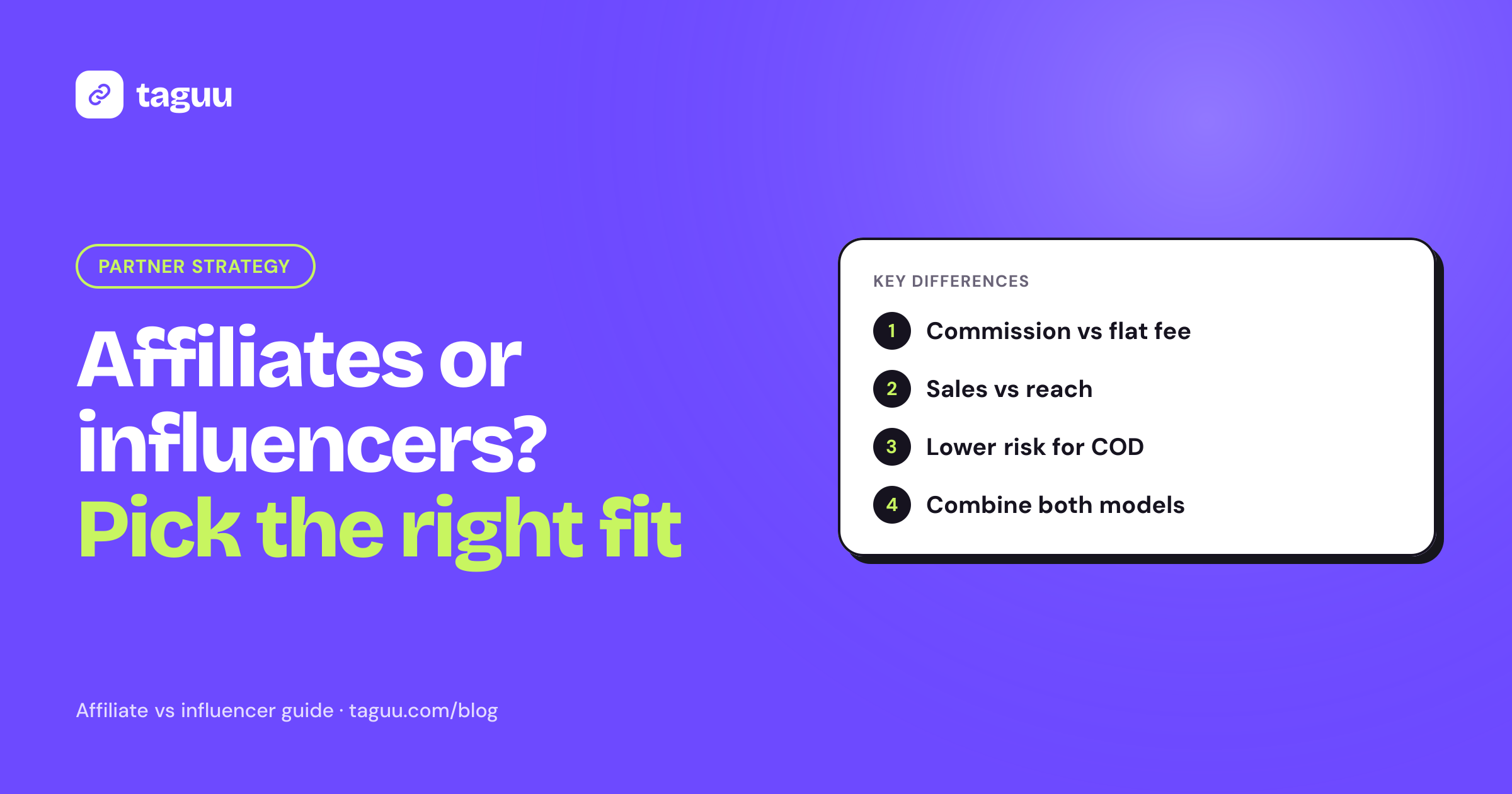
Affiliate vs influencer marketing is one of the first choices a Shopify merchant faces when they want other people to sell for them. Both use partners who talk about your products, but they differ in how you pay, what you measure, and how much risk you take. This guide explains each model in plain terms, compares them side by side, and shows how to combine them, with extra notes for stores that sell on cash on delivery (COD).
What is affiliate marketing?
Affiliate marketing is a performance-based model. A partner (the affiliate) shares a unique link or coupon code. When a customer buys through that link or code, the affiliate earns a commission. If nobody buys, you pay nothing.
Affiliates can be almost anyone:
- Bloggers and review sites
- Coupon and deal communities
- Social media creators of any size
- Happy customers who recommend you to friends
- WhatsApp and Facebook group admins
- Resellers who share your products with their own network
The key idea is simple: you pay for results, not for reach. Commissions are usually a percentage of the order value, or a fixed amount per order. If you are still deciding how much to pay, read our guide on affiliate commission rates.
What is influencer marketing?
Influencer marketing is a partnership with a creator who has an engaged audience. The brand pays the creator to make content about its products, such as a post, a reel, a video review, or a story series.
Payment is usually agreed upfront:
- A flat fee per post or per video
- A package price for a campaign (for example, three reels and five stories)
- A monthly retainer for ongoing content
- Free products in exchange for honest content (often called "gifting")
The creator gets paid whether or not the content sells anything. You pay for content and reach, not for sales. Influencer marketing is strong for brand awareness, trust, and new content you can reuse. For a full walkthrough, see our Shopify influencer marketing guide.
Affiliate vs influencer marketing: the key differences
The table below sums up the main differences. These are general patterns. Real deals often mix the two.
| Affiliate marketing | Influencer marketing | |
|---|---|---|
| Main goal | Sales and orders | Awareness, trust and content |
| How partners are paid | Commission per sale | Flat fee, package or free product |
| When you pay | After a sale happens | Usually before or at publishing |
| Your risk | Low: no sale, no cost | Higher: you pay even if nothing sells |
| Main metrics | Orders, revenue, conversion rate, cost per order | Reach, views, engagement, content quality |
| Partner size | Any size, including small accounts and customers | Usually creators with a clear audience |
| Tracking | Unique links, coupon codes | Views and likes, plus links or codes if you add them |
| Relationship length | Often long-term and always-on | Often campaign-based |
| Content control | Partner chooses how to promote | Brand usually approves a brief |
Payment and risk
This is the biggest difference. With affiliates, your cost moves with your sales. A slow month costs less. With influencers, you commit money before you know the result. A post can do very well or almost nothing, and the fee stays the same.
What you measure
Affiliate programs are measured in orders and revenue. You can see exactly which partner brought which sale. Influencer campaigns are often measured in reach and engagement. Those numbers are useful, but they do not always turn into sales you can count.
Who you work with
Influencer marketing usually means working with a smaller number of creators, picked carefully. An affiliate program can scale to hundreds of partners because each one only costs money when they sell. Many of the best affiliates are not "influencers" at all. They are customers, community admins, and niche bloggers.
When affiliate marketing is the better choice
Choose affiliate marketing first when:
- Your budget is small. You do not need cash upfront for fees.
- You need sales, not likes. Every partner is paid for orders.
- You sell on cash on delivery. You can tie commission to delivered and paid orders, so refused parcels do not cost you commission.
- You want many small partners. Micro-creators, customers and resellers can all join one program.
- You want clear numbers. Each order has a partner attached, so return on spend is easy to see.
When influencer marketing is the better choice
Choose a paid influencer campaign when:
- You are launching a new brand or product and people do not know you yet.
- You need content. Good creator videos and photos can be reused in ads, on product pages and in emails (with the creator's permission).
- Your product needs to be shown. Beauty, fashion and gadgets often sell better when people see them in use.
- You want a specific audience fast. A creator with the right followers can put you in front of them in one post.
Why the smartest stores combine both
You do not have to pick only one. Many Shopify stores use a hybrid model that takes the best of each.
Pay influencers with commission (or a mix)
Instead of a large flat fee, offer a creator one of these deals:
- Commission only: the creator gets a higher-than-usual commission on every sale from their link or code.
- Small fee plus commission: a modest fee covers their time, and commission rewards results.
- Free product plus commission: common with smaller creators who like the product.
This lowers your risk, and it rewards creators who really drive sales.
Turn your influencers into affiliates
Give every creator you work with a personal affiliate link and coupon code, even on a paid campaign. Now you can see which posts actually sold. Over time, you learn which creators are worth a bigger fee next time.
Turn your best affiliates into ambassadors
Some affiliates will sell steadily month after month. These are good candidates for a closer relationship: early access to new products, free samples, or a higher commission tier. Not sure where to find these partners? See how to find affiliates for your Shopify store.
Special notes for cash on delivery stores
COD changes the math for both models.
In many COD markets, a share of orders is cancelled, refused at the door, or returned. That means an order placed is not the same as an order paid.
- Influencer fees are paid regardless. If a creator drives many orders but many are refused, you still paid the full fee.
- Affiliate commissions can be made COD-safe. You only approve a commission after the order is delivered and the cash is collected, then wait a short hold period for returns.
This is why affiliate marketing is often a better fit for COD stores, and why a hybrid deal (small fee plus commission on delivered orders) works well with creators. We explain the full setup in COD affiliate marketing: pay commission only on delivered orders.
A few more COD tips:
- Use coupon codes, not just links. Many COD orders come through order forms, WhatsApp or phone. A code is easy to say and type, so the sale can still be credited.
- Watch for self-orders. If an affiliate's own phone number or email appears on an order, it should not earn commission.
- Agree on rules in writing. State clearly that commission is paid only on delivered, paid orders, and give the hold period.
How to choose: a simple decision guide
Ask yourself these questions:
- Do I have budget to pay before I see results? If no, start with affiliates.
- Do I need awareness or sales right now? Awareness points to influencers. Sales point to affiliates.
- Do I sell on COD? If yes, lean toward commission on delivered orders.
- Do I need new content for ads and my store? If yes, add a small paid influencer campaign.
- Can I track results? Whatever you choose, give each partner a unique link and code.
For many small and growing Shopify stores, a good plan looks like this:
- Start an always-on affiliate program open to customers, creators and community admins.
- Run a few small paid creator campaigns each quarter for content and launches.
- Give every creator an affiliate link and code so you can measure sales.
- Move top performers to better commission tiers instead of bigger flat fees.
Disclosure rules apply to both
Whether a partner is paid by commission, fee or free product, they usually need to tell their audience. In the US, the FTC Endorsement Guides (updated in 2023) say that a "material connection" such as a commission or a free product must be disclosed clearly. Many other countries have similar advertising rules.
Simple good practice:
- Ask partners to use clear labels such as "#ad", "sponsored" or "I earn a commission from this link."
- Put disclosure rules in your affiliate terms and influencer agreements.
- Check partner content from time to time.
Rules differ by country, so check the ones that apply to your markets.
How Taguu helps
Taguu is a Shopify affiliate app built for COD stores, and it works for both affiliates and creators:
- Give every partner an affiliate link (with UTM and ref code) and an optional personal coupon code.
- Commissions stay pending until the order is delivered (and paid for COD) plus a hold period (7 days by default). Cancelled, refused, returned and refunded orders are reversed automatically.
- Self-referrals are flagged and earn no commission.
- Partners get a branded sign-up page and a portal to see their orders, earnings and payouts.
- There is a free plan and 0% fee on sales on every plan.
You can install Taguu on your Shopify store and start your program today.
FAQ
What is the main difference between affiliate and influencer marketing?
Affiliates are paid a commission only when they make a sale. Influencers are usually paid a fee or free products for content, whether or not it sells.
Is affiliate marketing or influencer marketing better for a small Shopify store?
Affiliate marketing is usually easier to start on a small budget because you only pay for sales. You can add small paid influencer campaigns later when you need content or a launch push.
Can an influencer also be an affiliate?
Yes. You can give any creator a personal affiliate link and coupon code. Many brands pay creators with commission only, or with a small fee plus commission.
How should COD stores pay influencers?
Many COD stores prefer commission on delivered and paid orders, sometimes with a small fixed fee. This avoids paying for orders that are later refused or returned.
Do affiliates need to disclose that they earn a commission?
In most cases, yes. In the US, the FTC Endorsement Guides require clear disclosure of material connections such as commissions or free products. Check the rules in each country where you sell.