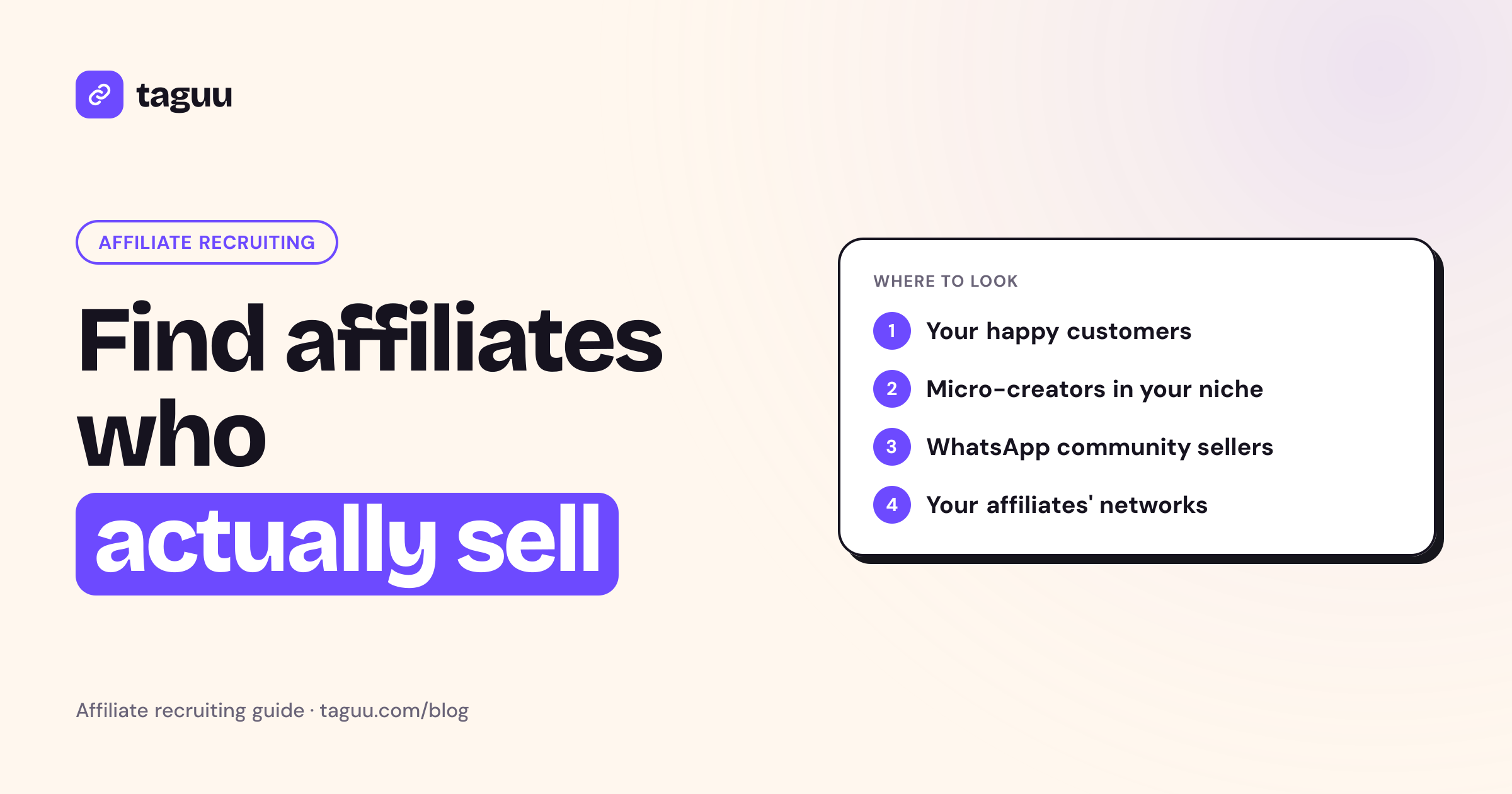
If you want to know how to find affiliates for your Shopify store, the good news is that your best partners are often closer than you think. Many of them already buy from you, follow you, or write about products like yours. This guide shows where to look, how to reach out, and how to pick affiliates who bring real, delivered orders instead of empty clicks.
Why finding the right affiliates matters more than finding many
A common mistake is to invite as many people as possible and hope some of them sell. In practice, a small group of active affiliates usually drives most of the results in a program. Ten people who know your products and talk to the right audience are worth more than two hundred who signed up and never shared a link.
This is even more true for stores that sell on cash on delivery (COD). A COD order only becomes revenue when the customer accepts the parcel and pays. Affiliates who push low-intent buyers can create many orders that are later refused or cancelled. So when you search for affiliates, look for trust and audience fit, not only follower counts.
Before you start, it helps to have the basics ready:
- A clear commission offer (see our guide to affiliate commission rates)
- A simple sign-up page where people can apply
- A way to give each affiliate a tracked link and, if you like, a personal coupon code
- Clear rules on when commissions are approved and paid
If you have not set these up yet, start with our step-by-step guide on how to start a Shopify affiliate program.
The 8 best places to find affiliates for your Shopify store
1. Your existing customers
Your happiest customers are often your easiest affiliates to recruit. They already like the product, and their friends and family trust their opinion. This works very well in markets where people buy through word of mouth and messaging apps.
How to reach them:
- Add an "Earn by sharing" link in your order confirmation and delivery emails or messages
- Send a short invite to customers who ordered more than once or left a good review
- Put a link to your affiliate sign-up page in your store footer
Customers rarely have a big audience, but they often have a high conversion rate because they share with people who know them.
2. Your social media followers
People who comment on your posts, tag your brand, or share your content are warm leads. Look through your recent comments, tags and direct messages. Anyone who posts about your products without being asked is a strong candidate.
Send them a short personal message. Thank them for the post, explain the program in two sentences, and share the sign-up link.
3. Micro-creators in your niche
Micro-creators are people with smaller, focused audiences. They often have closer relationships with their followers than large accounts do, and they are more likely to accept a commission-only deal.
How to find them:
- Search hashtags related to your product category on Instagram and TikTok
- Look at who your competitors' customers follow and who posts reviews of similar products
- Check YouTube for "review", "unboxing" and "haul" videos in your category
- Look at who is active in Facebook groups and online communities about your niche
When you review a creator, check engagement and comments, not only follower count. Real questions in the comments ("Where can I buy this?" "Does it come in other sizes?") are a good sign. For more on working with creators, read our Shopify influencer marketing guide.
4. Shopify Collabs and creator marketplaces
Shopify offers Shopify Collabs, an app that helps merchants find creators, accept applications, and run affiliate partnerships. Other affiliate networks and creator marketplaces also list people who are looking for brands to promote.
Marketplaces are useful because the people there are already looking for programs. The trade-off is that they also see many other offers, so your commission, product and terms need to stand out. Check each platform's current features, fees and country availability before you commit, since these change over time.
5. Bloggers and niche websites
Content sites that publish buying guides, comparisons and how-to articles can send steady traffic for months or years. Search Google for phrases like:
- "best [your product type]"
- "[your product type] review"
- "[problem your product solves] tips"
Look at who ranks on the first pages. Smaller blogs are often happy to add a product they like if the commission is fair and you send them a free sample.
6. WhatsApp resellers and community sellers
In many COD markets, a lot of selling happens inside WhatsApp groups, Telegram channels and Facebook groups. Some people already earn money by sharing products with their community. These sellers can become strong affiliates because they know how to talk to buyers who prefer to pay on delivery.
When you recruit them, make the offer simple: a link, a code, a clear commission, and a clear payout method such as a bank transfer or mobile wallet.
7. Complementary brands and service providers
Think about businesses that serve the same customers but do not compete with you. A skincare store might partner with makeup artists or salons. A fitness gear store might partner with personal trainers or gyms. A baby products store might partner with parenting pages.
These partners can promote you to their clients through newsletters, social posts or in person.
8. Your own affiliates' networks
Good affiliates often know other people who would do well in your program. An invite-and-earn (two-tier) setup rewards an affiliate when someone they invite starts making sales. This turns your best partners into recruiters. Keep it to one level so it stays simple and fair.
Comparing the main sources
Here is a quick view of the trade-offs. Use it as a starting point, not a rule, since results depend on your product and market.
| Source | Effort to recruit | Typical audience size | Trust level | Good for COD stores? |
|---|---|---|---|---|
| Existing customers | Low | Small | High | Yes, strong word of mouth |
| Social followers | Low | Small to medium | High | Yes |
| Micro-creators | Medium | Medium | Medium to high | Yes, if audience is local |
| Creator marketplaces | Low to medium | Varies | Varies | Depends on audience location |
| Bloggers and niche sites | Medium to high | Medium | Medium | Good for research-driven buyers |
| WhatsApp and community sellers | Medium | Small to medium | High | Very good |
| Complementary brands | High | Varies | High | Yes |
| Affiliates' networks | Low | Varies | Medium | Yes |
How to write an outreach message that gets replies
Most people ignore generic messages. A short, personal note works better. Use this simple structure:
- Personal opening. Mention a specific post, video or review of theirs.
- Why them. Say in one sentence why their audience fits your product.
- The offer. Commission rate, any coupon for their followers, and free product if you offer it.
- How it works. One line on tracking and payouts.
- One clear next step. A link to your sign-up page.
Example:
Hi Sara, I loved your video on simple morning skincare routines. Your followers ask a lot about gentle cleansers, which is exactly what we make. We pay 15% commission on every delivered order, and your followers get 10% off with your own code. You can see your orders and earnings anytime in your affiliate dashboard. Want to join? Here is the sign-up page: [link]
Follow up once after about a week if you get no reply. After that, move on.
How to choose which affiliates to approve
Not everyone who applies should be approved. A short review protects your brand and your margins.
Check audience fit
- Are their followers in the countries you ship to?
- Do they talk about topics related to your products?
- Does their tone match your brand?
Check engagement quality
- Are comments real conversations, or just emojis and generic praise?
- Do followers ask questions about products they share?
- Is engagement steady across posts, or does it jump in odd ways?
Check promotion methods
Ask applicants how they plan to promote you. Be careful with anyone who plans to:
- Bid on your brand name in search ads without permission
- Post coupon codes on coupon sites if you do not allow that
- Send spam messages or use misleading claims
Put your rules in your affiliate terms so everyone knows them from day one.
Set up your program so new affiliates succeed
Finding affiliates is only half the job. If they sign up and do not know what to do, they will stop. Give every new affiliate a good start:
- A welcome message with their link, code and a short how-to
- Ready-to-use content such as product photos, short videos and sample captions
- Clear rules on what is allowed and when commissions are paid
- Fast, reliable payouts using methods they can actually use, such as bank transfers, mobile wallets or PayPal
- A dashboard where they can see their orders and earnings without asking you
For COD stores, explain clearly that commissions are approved only after the order is delivered and paid. This is fair to you and it sets the right expectation. Affiliates understand it when you tell them upfront. Read more in our guide to COD affiliate marketing.
Track results and keep the best partners
After the first month, look at each affiliate's numbers:
- Orders and delivered orders
- Cancelled, refused and returned orders
- Approved commissions
- Repeat customers
Reward your best affiliates with higher commission tiers, early access to new products or extra free samples. For affiliates who never shared a link, send one friendly reminder with fresh content. If they stay inactive, that is fine. Focus your time on the people who are selling.
Watch for warning signs, too. Orders placed by the affiliate themselves, or many orders from the same customer through one affiliate, deserve a closer look before you approve commission.
How Taguu helps you recruit and manage affiliates
Taguu is a Shopify affiliate app built for stores that sell on cash on delivery. It gives you a branded affiliate sign-up page to share with customers, followers and creators. Each affiliate gets links for any product and an optional personal coupon code, and an affiliate portal to see their orders, earnings, payouts and links. Commissions stay pending until the order is delivered (and paid for COD) plus a hold period, and cancelled, refused or returned orders are reversed automatically. Invite & earn lets your affiliates recruit others for a team bonus, one level only. Self-referrals are flagged and get no commission. There is a Free plan for up to 50 affiliate orders a month and 0% fee on sales on every plan. Install Taguu to start building your affiliate team.
FAQ
Where is the easiest place to find affiliates for a new Shopify store?
Start with your existing customers and social media followers. They already know and like your products, so they are easier to recruit than strangers. Add a sign-up link to your store footer and order emails.
How many affiliates should I recruit at first?
There is no fixed number. A practical starting point is to aim for a small group of active, well-matched affiliates and support them well, then grow from there once you know what works.
Should I only work with influencers who have large followings?
No. Smaller creators and community sellers often have closer relationships with their audience. For many small brands and COD stores, they can bring more delivered orders than a large account.
How do I stop affiliates from earning on orders that are never delivered?
Approve commissions only after the order is delivered and paid, and add a short hold period for returns. Make this rule clear in your affiliate terms before anyone joins.
Can my affiliates help me find more affiliates?
Yes. A two-tier or invite-and-earn program gives affiliates a bonus when people they invite make sales. Keeping it to one level keeps it simple and easy to manage.