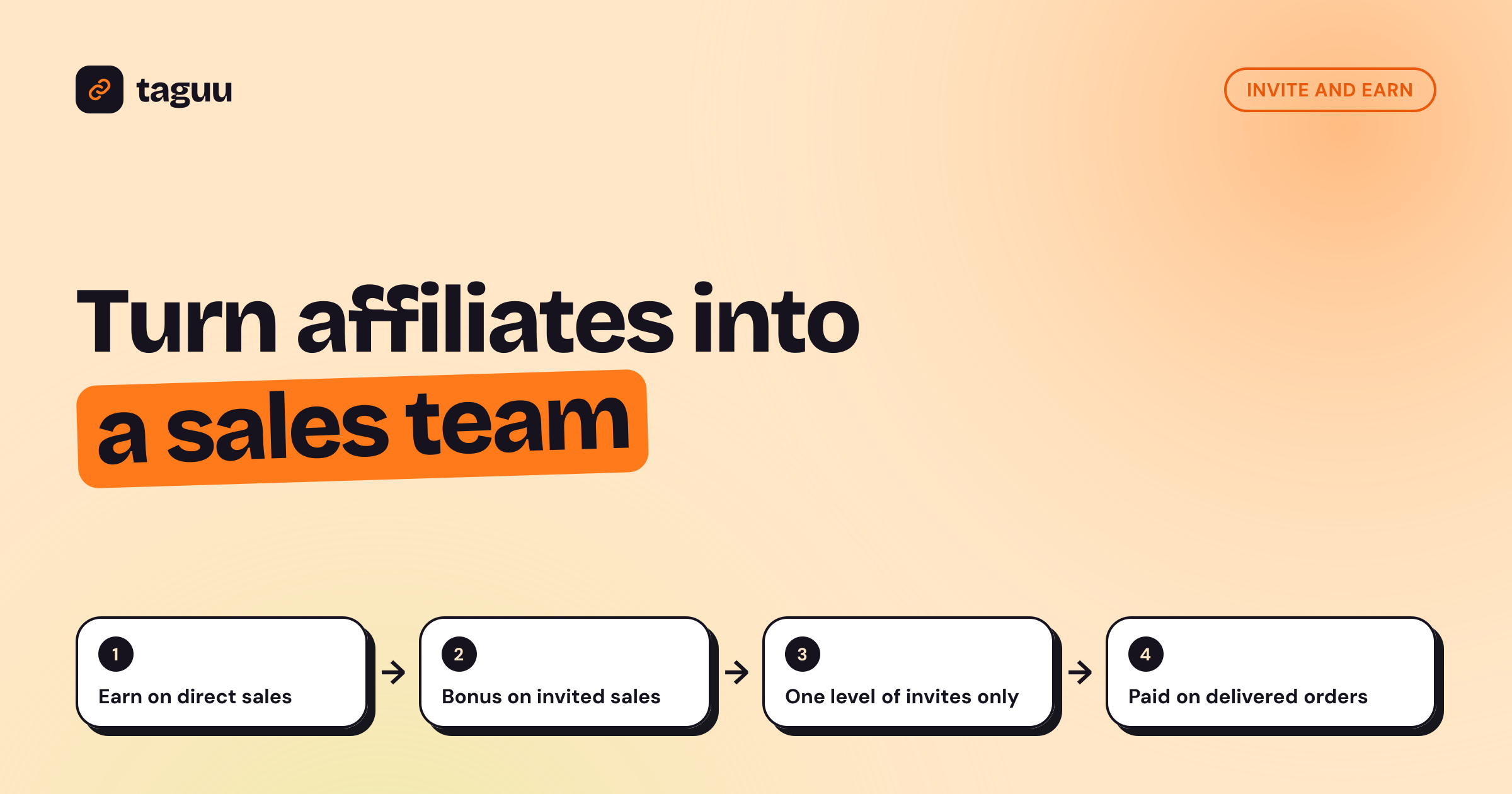
A two-tier affiliate program lets your best affiliates invite other affiliates and earn a small bonus on the sales those new affiliates make. It is a simple way to turn one strong partner into a small team that grows your Shopify store. This guide explains how a two-tier affiliate program works, how to set the numbers, how to keep it fair and legal, and how to run it safely when many of your orders are cash on delivery (COD).
What is a two-tier affiliate program?
In a normal affiliate program, there is one level. An affiliate shares a link or coupon code, a customer buys, and the affiliate earns a commission.
A two-tier affiliate program adds a second level:
- Tier 1: The affiliate earns a commission on the sales they refer directly.
- Tier 2: The affiliate also earns a smaller bonus on the sales made by affiliates they invited to your program.
You may also see this called "invite and earn," "team bonus," "sub-affiliate commission" or "override commission." The idea is the same. The person who brings in a new affiliate gets rewarded when that new affiliate produces real sales.
The key words are "two tiers." The bonus stops after one level of invites. If Affiliate A invites Affiliate B, and B invites Affiliate C, then A earns a bonus on B's sales, B earns a bonus on C's sales, and A earns nothing from C.
Why Shopify stores use two-tier programs
Recruiting affiliates takes time. You send messages, explain your offer and answer the same questions again and again. Your best affiliates already know people like them: other creators, resellers, community admins and friends who sell online. A team bonus gives them a reason to make those introductions for you.
Common benefits:
- Cheaper recruiting. Your affiliates find new partners, so you spend less time on outreach.
- Better-fit partners. People tend to invite others with similar audiences, which often means affiliates who already know how to sell your type of product.
- Built-in mentoring. An affiliate who earns from a teammate's sales has a reason to help that teammate succeed. They share what posts work, which products sell and how to answer customer questions.
- Loyalty. Affiliates with a team are less likely to leave for another program, because they would lose their team bonus.
If you are still building your first group of partners, start with our guide on how to find affiliates for your Shopify store. A two-tier program works best once you have a few active affiliates who can invite others.
Two-tier affiliate program vs MLM
Some merchants worry that a two-tier program looks like multi-level marketing (MLM) or a pyramid scheme. The concern is fair, so it is worth being clear about the difference.
The US Federal Trade Commission (FTC) has published business guidance on multi-level marketing. It explains that a program becomes a problem when the focus is on recruiting people rather than selling products to real customers. It also warns that buying products just to qualify for recruitment rewards is a sign of a pyramid scheme.
A healthy two-tier affiliate program avoids those patterns:
| Feature | Healthy two-tier affiliate program | Pyramid-style scheme |
|---|---|---|
| How money is earned | Only from real customer orders | Mainly from recruiting people |
| Joining fee | Free to join | Often requires a fee or starter kit |
| Required purchases | None | Often must buy stock to qualify |
| Number of levels | Two (direct sales + one level of invites) | Many or unlimited levels |
| Bonus for signing someone up | None; bonus only on that person's sales | Paid just for the sign-up |
Simple rules keep you on the right side:
- Never charge affiliates to join or to unlock team bonuses.
- Never pay a bonus just because someone signed up. Pay only on approved sales.
- Never require affiliates to buy products.
- Keep it to one level of invites.
- Do not make income promises in your recruiting messages.
Laws differ by country, so if you are unsure, ask a local lawyer to review your terms.
How the money works
There are two common ways to calculate the tier-2 bonus.
Option 1: A percentage of the sale
The inviter earns a small percentage of the order value. For example, a $50 order might pay the direct affiliate 10% ($5) and the inviter 2% ($1).
Option 2: A percentage of the invited affiliate's commission
The inviter earns a share of the commission the invited affiliate earned. For example, if the invited affiliate earns $5 and the team bonus is 20%, the inviter earns $1.
Option 2 is easier to explain and easier to budget. The bonus always moves in step with your main commission. If you raise or lower a product's commission, the team bonus follows automatically.
Who pays the bonus?
This matters more than it looks. In most two-tier programs, the merchant pays the team bonus on top of the direct affiliate's commission. The invited affiliate still gets their full commission. Nobody's earnings are cut to pay the inviter.
If you take the bonus out of the invited affiliate's commission instead, new affiliates may feel they are paying a fee to the person who invited them. That hurts trust.
Typical starting points
There is no standard rate, and you should test what works for your margins. Typical starting points:
- Team bonus as a share of commission: 10% to 20% of the invited affiliate's approved commission.
- Team bonus as a share of sale: a small fraction of your main rate, often a few percent of the order value.
To check your budget, add the two numbers together. If your main commission is 10% of the sale and your team bonus is 20% of that commission, your total affiliate cost on a team order is 12% of the sale. Make sure that still leaves room for shipping, returns and profit.
A simple example
Here is how one month might look. All numbers are made up to show the math.
- Sara is an affiliate. Her commission rate is 10%.
- Sara invites Ali to join your program using her invite link.
- Ali refers 20 orders worth $40 each, a total of $800.
- Ali earns 10% of $800, which is $80.
- Sara earns a 20% team bonus on Ali's approved commission: 20% of $80 is $16.
- Your total affiliate cost for those orders is $96, which is 12% of the sales.
If two of Ali's orders are refused at the door, his commission drops, and so does Sara's bonus. The bonus always follows approved sales only.
Running a two-tier program with COD orders
Cash on delivery makes affiliate payouts harder, and a second tier adds one more layer. A COD order is not real money until the customer pays the courier. Some orders are cancelled, refused or returned. If you pay commissions when the order is placed, you may pay both the affiliate and the inviter for a sale that never happened.
Follow these rules:
- Pay only on delivered and paid orders. Keep commissions pending until the courier confirms delivery and payment.
- Add a hold period. Wait a few days after delivery before approving, so returns and refunds can come in first.
- Reverse both tiers together. If an order is cancelled, refused, returned or refunded, reverse the direct commission and the team bonus at the same time.
- Recalculate on partial refunds. If a customer returns one item from a three-item order, both the commission and the bonus should shrink to match.
We cover the full COD payout flow in COD affiliate marketing: pay commission only on delivered orders.
Protecting your program from abuse
A team bonus creates a new way to cheat: an affiliate can invite a "second account" that is really themselves, or invite a friend who places fake orders. Watch for these patterns:
- Self-referrals. The order email or phone number matches the affiliate's own details. No commission should be paid, and no team bonus should flow up from it.
- Repeat customers through one affiliate. The same customer buying again and again through the same affiliate may be a friend or family member gaming the system.
- High refusal rates. An invited affiliate whose COD orders are often refused may be sending low-quality or fake orders.
- Many invites, few sales. An affiliate who invites dozens of people who never sell may be chasing a sign-up reward. This is one more reason to pay only on sales.
Because COD orders are paid in cash at the door, fake orders cost you shipping both ways. Read our full guide on affiliate fraud: self-referrals and fake orders for more checks.
How to launch your two-tier program
1. Decide the rules
Write down your team bonus rate, who pays it, which orders qualify, your hold period and what happens on refunds. Keep it to one level of invites.
2. Update your terms
Add a short "Team bonus" section to your affiliate terms. State that bonuses are paid only on approved sales, that there is no fee to join and that you can remove bonuses earned through fraud.
3. Give affiliates an invite link
Each affiliate needs a personal invite link to your sign-up page. When someone joins through it, they are linked to the inviter automatically. Avoid manual tracking in spreadsheets; it causes disputes.
4. Announce it to your best affiliates first
Start with your top performers. They are most likely to invite people who will actually sell. Explain the bonus with a simple example like the one above.
5. Show the team in the affiliate portal
Affiliates should see who joined through their link and how much team bonus they have earned. Clear numbers prevent support tickets and build trust. Do not show customer details.
6. Review after 60 to 90 days
Check how many new affiliates came from invites, how many of them made a sale and what your total affiliate cost was as a share of sales. Adjust the rate if needed.
Mistakes to avoid
- Paying for sign-ups. It invites fake accounts and moves you toward a recruitment-based model.
- Unlimited levels. More levels make the math confusing and increase legal risk.
- Cutting the invited affiliate's pay. Pay the bonus on top, not out of their commission.
- Paying on placed COD orders. Wait for delivery and payment.
- Hiding the rules. Put the bonus rate and conditions in your terms and on your sign-up page.
How Taguu helps
Taguu is a Shopify affiliate app built for stores that sell on COD, and it includes a built-in invite and earn feature:
- Each affiliate can invite other affiliates. The inviter earns a team bonus (20% by default) of the invited affiliate's approved commission, paid by you on top. It goes one level only.
- Commissions stay pending until the order is delivered (and paid for COD) plus a hold period (7 days by default). Cancelled, refused, returned and refunded orders are reversed automatically, and partial refunds are recalculated.
- Self-referrals get no commission and are flagged, and repeat customers through one affiliate are flagged for review.
- Affiliates see their orders, earnings, payouts, links and team in their portal, with no customer details shown.
There is a Free plan for up to 50 affiliate orders a month, and 0% fee on sales on every plan. You can install Taguu and try it on your store.
FAQ
Is a two-tier affiliate program the same as MLM?
No. A two-tier affiliate program pays only on real customer orders, is free to join and stops at one level of invites. Programs that pay mainly for recruiting, charge joining fees or require product purchases carry the risks the FTC describes in its guidance on multi-level marketing.
How much should I pay for the second tier?
There is no standard. A typical starting point is 10% to 20% of the invited affiliate's commission, paid on top. Check that your total affiliate cost still fits your margins.
Does the invited affiliate earn less?
It should not. In a well-designed program, the merchant pays the team bonus on top, so the invited affiliate keeps their full commission.
When should I pay team bonuses on COD orders?
Only after the order is delivered and the cash is collected, plus a short hold period for returns. If the order is later refunded or returned, reverse both the commission and the team bonus.
Can an affiliate earn from people their invitees recruit?
Not in a two-tier program. The bonus covers one level only. This keeps the program simple, fair and focused on selling products.