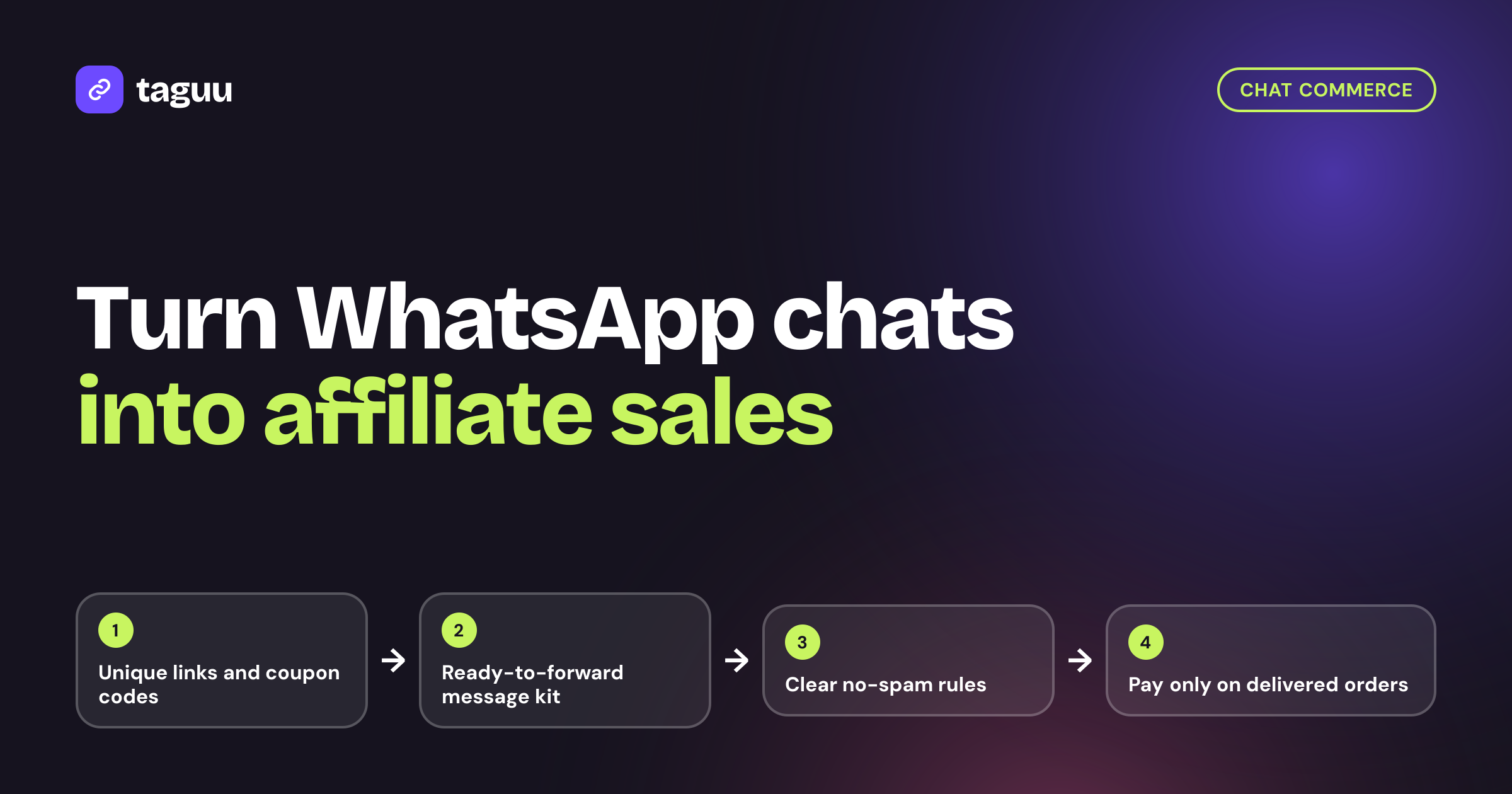
WhatsApp marketing with affiliates means your affiliates share your products with their own WhatsApp contacts, groups, Status and Channels, and earn a commission on the orders they bring. For stores that sell on cash on delivery (COD), it is often a strong fit, because many buyers already ask questions and confirm orders on WhatsApp. This guide shows how to set it up, how to track sales from private chats, and how to keep it honest and profitable.
Why WhatsApp and affiliates work well together
Most affiliate marketing advice is built around blogs, YouTube and Instagram. Those channels are public. WhatsApp is different. It is a private, trust-based space. A message from a friend, a cousin or a local community admin feels personal, not like an ad.
That matters for a few reasons:
- Trust drives the sale. People are more likely to try a new store when someone they know vouches for it.
- It fits how COD shoppers buy. In many markets, buyers want to ask "Is this original?" or "How long is delivery?" before they order. An affiliate on WhatsApp can answer right away.
- Anyone can be an affiliate. You do not need a large following. A person with a few active family and community groups can drive real orders.
- It is low cost for you. You pay commission only on sales, and with COD you can wait until the order is delivered before you approve it.
The challenge is that WhatsApp is a "dark social" channel. Analytics tools often cannot see where a click came from, because private chats do not pass a clear referrer. So tracking needs a plan from day one.
Where affiliates can share on WhatsApp
WhatsApp gives affiliates several ways to reach people. Each one works a bit differently.
One-to-one chats
The most personal option. An affiliate sends a product link to someone who asked about it, or to a friend they think would like it. Conversion is often high, but reach is small.
Groups
Family, neighborhood, school, hobby and buy-and-sell groups are common in many markets. An affiliate who is an active member, or an admin, can share offers there. Group rules matter: spam gets people removed fast.
Status
WhatsApp Status works like stories. Updates disappear after 24 hours and are seen by the affiliate's contacts. It is a good place for product photos, short videos and "today only" deals.
Broadcast lists
On the WhatsApp Business app, a broadcast list sends one message to many contacts, and each person gets it as a private chat. A key rule: people only receive broadcast messages if they have saved the sender's number. That makes broadcasts a tool for warm contacts, not cold outreach. Third-party guides commonly cite a limit of 256 contacts per list, but WhatsApp can change limits, so check the current rules in the app.
Channels
WhatsApp Channels are one-way broadcasts that people choose to follow. According to WhatsApp's launch announcement, the admin's phone number is not shown to followers, and followers' numbers are not shown to the admin. Channels suit affiliates who run a deals page or a niche community and want to post regularly.
Which option to use
| Option | Reach | Personal feel | Best for |
|---|---|---|---|
| One-to-one chat | Very small | Very high | Answering questions, closing a sale |
| Groups | Medium | High | Community and local offers |
| Status | Medium (own contacts) | Medium | Daily deals, new arrivals |
| Broadcast list | Medium (saved contacts only) | High | Regular offers to warm contacts |
| Channels | Can be large | Lower | Deal pages and niche communities |
Encourage affiliates to mix these. A Status post can spark interest, and a one-to-one chat can close the sale.
How to track affiliate sales from WhatsApp
Because WhatsApp chats are private, you cannot rely on "referrer" data. You need tracking that travels with the link or the order itself. There are three tools you can combine.
1. Affiliate links with a ref code and UTM parameters
Give every affiliate a unique link for any product. The link should carry a referral code and UTM tags such as utm_source=whatsapp and utm_medium=affiliate. When a shopper taps the link in a chat, the tags tell your store who sent them. If you are new to this, read our guide to UTM parameters for affiliate links.
A few tips for WhatsApp links:
- Keep links clean. A short product link with a clear preview looks trustworthy. A long, messy link looks like spam.
- Link to the product, not just the home page. Fewer taps means more orders.
- Test the preview. Send the link to yourself first to check that the image and title look right.
2. Affiliate coupon codes
Coupon codes are very useful on WhatsApp. People forward messages, take screenshots and tell friends by voice note. A link can get lost along the way, but a code like SARA10 survives. When the buyer enters the code at checkout, the sale is credited to that affiliate even if they never clicked a link. We compare both methods in detail in affiliate coupon codes vs affiliate links.
3. A referral cookie that survives COD forms
Many COD stores use a one-page order form app instead of the standard checkout. Some tracking tools lose the affiliate at this step. Make sure your tracking saves the referral on the cart, so the order is still credited when the buyer submits a COD form.
Decide your attribution rules
Write down who gets credit when more than one thing happens. A common setup is:
- If an affiliate coupon is used, that affiliate gets the sale.
- If not, the last affiliate link clicked gets the sale.
- If neither is present at checkout, a saved referral on the cart decides.
Tell your affiliates these rules up front. It prevents arguments later, especially when two people share the same deal in the same group.
How to set up a WhatsApp affiliate program, step by step
Step 1: Pick the right affiliates
The best WhatsApp affiliates are not always the ones with big social profiles. Look for:
- Happy customers who already recommend you
- Community or group admins in your niche
- Local resellers and students who want side income
- Micro-influencers who move their followers into WhatsApp groups or Channels
Step 2: Set a simple commission
Keep it easy to explain in one sentence, such as "10% of every delivered order." Many stores start with a flat percentage and adjust after a few months. Typical starting points vary a lot by product margin, so check our guide on affiliate commission rates before you choose.
Step 3: Make sign-up easy
Share a sign-up page link that affiliates can open on their phone. Ask only for what you need: name, phone, email and how they want to be paid. Many WhatsApp affiliates do not have a website, so do not make that a requirement.
Step 4: Give them a ready-to-share kit
Most affiliates will not write their own copy. Give them content they can forward in one tap:
- Short messages in the languages your buyers use
- Square product photos and short vertical videos for Status
- Their personal link and coupon code
- Answers to common questions (delivery time, return policy, COD fees)
Here is a simple message template affiliates can copy:
I've been using this [product] and really like it. You can order with cash on delivery here: [your link]. Use my code [CODE] for [offer]. Message me if you have any questions!
Step 5: Set clear WhatsApp rules
Put these in your affiliate terms:
- Only message people who know you or have agreed to hear from you
- Follow each group's rules, and do not spam groups you are not part of
- Do not make health, income or "guaranteed" claims you cannot back up
- Do not pretend to be the brand or its official support
- Do not post misleading prices or fake "last stock" alerts
Spam can get the affiliate's number restricted by WhatsApp, and it can hurt your brand. Clear rules protect both of you.
Step 6: Keep affiliates active
Run a simple WhatsApp group or Channel for your affiliates. Post new products, weekly offers and top performers there. A short message every week keeps your brand top of mind.
Protect your margins on COD orders
WhatsApp sales are often COD sales. That brings two risks: orders that are refused at the door, and fake orders placed to earn commission.
Pay only on delivered orders
The safest rule is to keep commissions pending until the order is delivered and the cash is collected, then wait a short hold period for returns. If an order is cancelled, refused, returned or refunded, the commission should be reversed. Our guide to COD affiliate marketing explains this flow in more detail.
Watch for self-referrals and fake orders
WhatsApp makes it easy to share a link with yourself, or to ask friends to place orders that are later refused. Warning signs include:
- The order phone number or email matches the affiliate
- Many orders to the same address or from the same customer through one affiliate
- A sudden spike of orders with a high refusal rate
Check these patterns regularly. Read more in affiliate fraud: self-referrals and fake orders.
Ask affiliates to confirm interest
A good WhatsApp affiliate does more than drop a link. They answer questions, set clear delivery expectations and make sure the buyer really wants the product. That reduces refusals at the door, which helps you and their earnings.
Metrics to watch
Track a small set of numbers for each affiliate:
- Orders placed through their link or code
- Delivery rate: the share of orders that were actually delivered and paid
- Approved commission after returns and refusals
- Average order value
- Repeat customers they bring back
An affiliate with fewer orders but a high delivery rate is often worth more than one with many orders that get refused.
Common mistakes to avoid
- No tracking plan. Without unique links and codes, WhatsApp sales show up as "direct" traffic and you cannot reward the right person.
- Paying on order placed. On COD, this pays for orders that never get delivered.
- Too many rules, too little support. Give affiliates content and quick answers, not just a list of don'ts.
- Ignoring group etiquette. One spammy affiliate can damage your name in a whole community.
- Slow payouts. Pay on a fixed schedule in a way your affiliates can actually use, such as bank transfer or a mobile wallet.
How Taguu helps
Taguu is a Shopify affiliate app built for COD stores, and it fits the WhatsApp workflow:
- Affiliate links for any product (UTM + ref code), plus an optional coupon code per affiliate that you create
- Attribution that checks the affiliate coupon first, then the last UTM click, then a referral cookie saved on the cart, so it works with COD form apps
- Commissions stay pending until the order is delivered (and paid for COD) plus a hold period (7 days by default); cancelled, refused, returned and refunded orders are reversed automatically
- Self-referrals get no commission and are flagged, and repeat customers through one affiliate are flagged
- A branded sign-up page and a mobile-friendly affiliate portal, plus payouts recorded with a reference for bank transfer, mobile wallets or PayPal
There is a free plan for up to 50 affiliate orders per month, and 0% fee on sales on every plan. You can install Taguu on your Shopify store to get started.
FAQ
Is it allowed to promote products on WhatsApp as an affiliate?
Yes, as long as affiliates follow WhatsApp's terms and policies and the rules of each group. They should only message people who know them or agreed to receive messages, and avoid spam or misleading claims.
How do I track affiliate sales that come from WhatsApp chats?
Give each affiliate a unique link with a ref code and UTM tags, plus their own coupon code. The code covers sales where the link was lost through forwards, screenshots or voice notes.
Should affiliates use the WhatsApp Business app?
It helps. The Business app adds tools like a business profile, catalog and broadcast lists. Casual affiliates sharing with friends can still use regular WhatsApp.
When should I pay commission on WhatsApp COD orders?
Pay only after the order is delivered and the cash is collected, plus a short hold period for returns. Reverse commission on cancelled, refused or returned orders.
What commission should I offer WhatsApp affiliates?
Start with a simple flat percentage that your margins can support, then adjust based on delivery rates and results. Keep it easy to explain in one sentence.